

Quick answer
Vitality Bone uses 500–1000 micron particles to help balance space maintenance, mechanical stability, blood supply, and predictable bone remodeling during oral surgery and implant-related grafting workflows.
Compared with smaller particles, larger particles possess greater mechanical resistance, reducing the risk of premature chemical dissolution and improving space-maintaining capability.
Allograft bone substitutes must be retained during bone formation in order to support osteoblast function. In instances where bone substitutes are not successfully retained, there is an elevated risk of defective, insufficient bone formation. Conversely, smaller particles possess greater shapeability and more rapid dissolution, reducing the overall time needed for bone formation.
Vitality Bone Particulate Allograft consists of a 500-1000 micron particle size in order to maximize the quality of bone formation while maintaining a turnover period of approximately 4 months.
Why 500–1000 micron particle size matters
Bone graft particle size affects how well the graft maintains space, supports cell attachment, allows blood supply, and remodels into new bone. Particles that are too small may resorb too quickly, while particles that are too large may be harder to adapt to the graft site.
Practical takeaway
The 500–1000 micron range is designed to help Vitality Bone maintain graft structure while supporting predictable turnover during healing.

Particle size comparison
| Particle size | Possible behavior | Clinical meaning |
|---|---|---|
| Smaller particles | May resorb faster and be easier to pack into tight areas. | May not provide enough space maintenance in larger grafting sites. |
| Vitality Bone 500–1000 microns | Designed to balance graft stability, space maintenance, and remodeling. | Useful for socket preservation, ridge augmentation, and implant-related workflows. |
| Very large particles | May offer structure but can be less adaptable in some sites. | May not be ideal where close adaptation is needed. |
Compare Vitality Bone Graft Options
Explore Vitality 500–1000 micron allograft sizes for socket preservation, ridge augmentation, and implant-related grafting workflows.
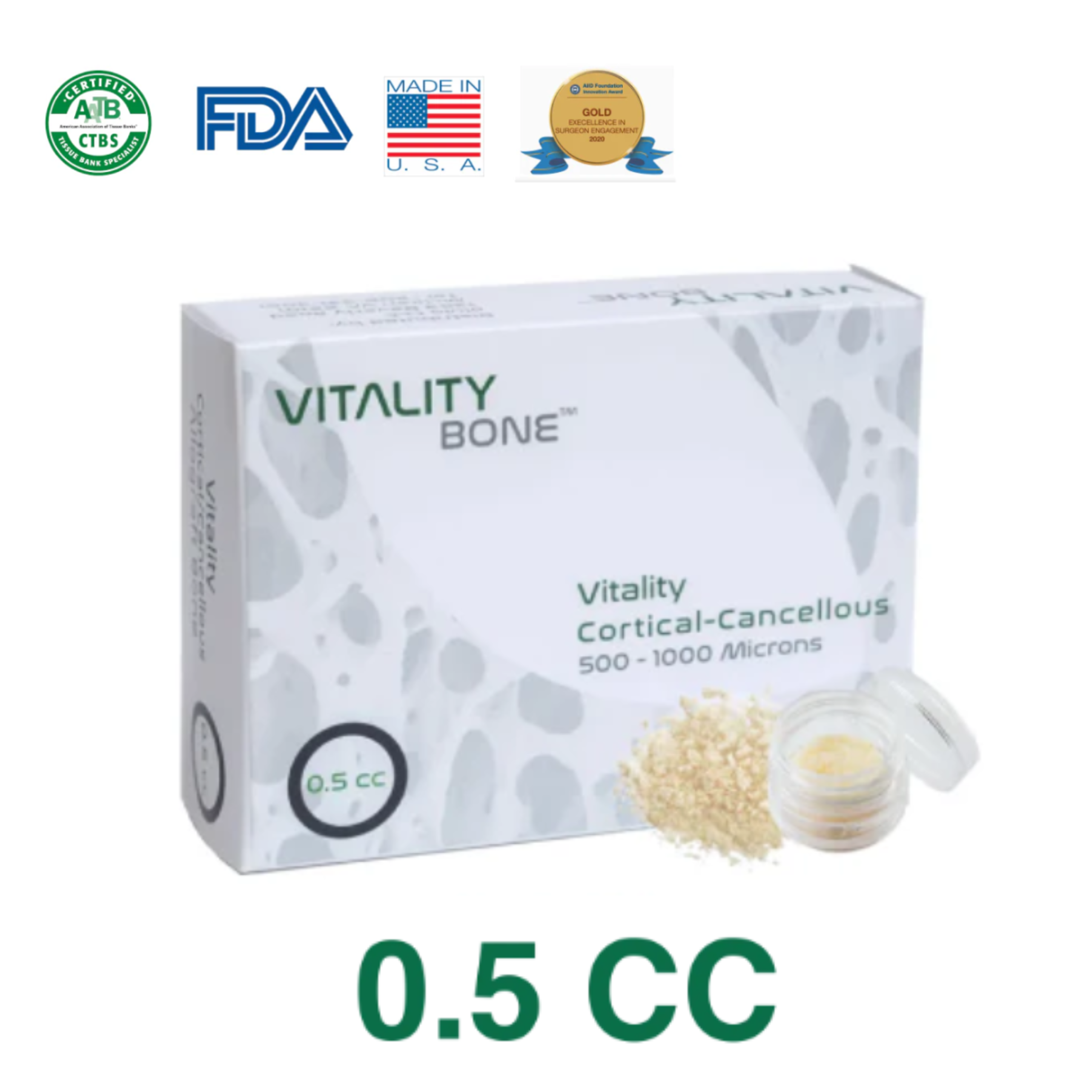
0.5 CC Allograft
Suitable for smaller socket preservation and focused grafting cases.
View 0.5 CC Product
1.0 CC Allograft
A balanced option for common implant-related grafting and ridge support needs.
View 1.0 CC Product
2.0 CC Allograft
Useful for larger ridge augmentation or higher-volume grafting workflows.
View 2.0 CC Product
Want to compare Vitality Bone options?
View 0.5 CC, 1.0 CC, and 2.0 CC allografts designed with 500–1000 micron particles for oral surgery and implant-related grafting workflows.
Compare Vitality allograft products →
Dr. Hamid Shafie
Director of postdoctoral implant training at Washington Hospital Center
Department of Oral and Maxillofacial Surgery