

When selecting the ideal grafting material, understanding the difference between cancellous bone graft and cortical bone graft is essential—especially for procedures that demand both strength and rapid healing.
Cancellous bone is known for its high porosity and large trabecular surface area, which allows a greater concentration of osteoblasts and osteocytes. This results in enhanced osteogenic potential and promotes faster vascularization and biological incorporation at the surgical site.
In contrast, cortical bone graft provides superior mechanical strength and structural stability. Its dense composition is ideal for maintaining graft volume and space during horizontal and vertical bone augmentation, especially in the alveolar ridge.
By combining both types, the Vitality Bone 70/30 Cortical-Cancellous Mix delivers the best of both worlds: the biological activity of cancellous bone and the supportive structure of cortical bone. This balanced ratio makes it a top choice for clinicians seeking predictable graft performance in challenging cases.
Cortical vs. Cancellous Bone Graft
Cortical and cancellous bone have different structural characteristics, which is why combining them can support different grafting needs.
| Feature | Cortical Bone | Cancellous Bone |
|---|---|---|
| Structure | Dense and compact | Porous and trabecular |
| Primary Benefit | Helps maintain graft volume and structural stability | Supports vascularization and biological incorporation |
| Remodeling | Generally slower | Generally faster |
| Clinical Role | Provides structural support | Supports biological activity |
Why the 70/30 cortical-cancellous mix matters
The cancellous portion supports biological activity and faster incorporation, while the cortical portion helps maintain graft volume and structural stability during ridge augmentation and implant-related grafting cases.
Choose Your Vitality Auto-Delivery Size
Compare Vitality allograft sizes for recurring practice inventory needs. Save 30% with Auto-Delivery and receive free shipping.
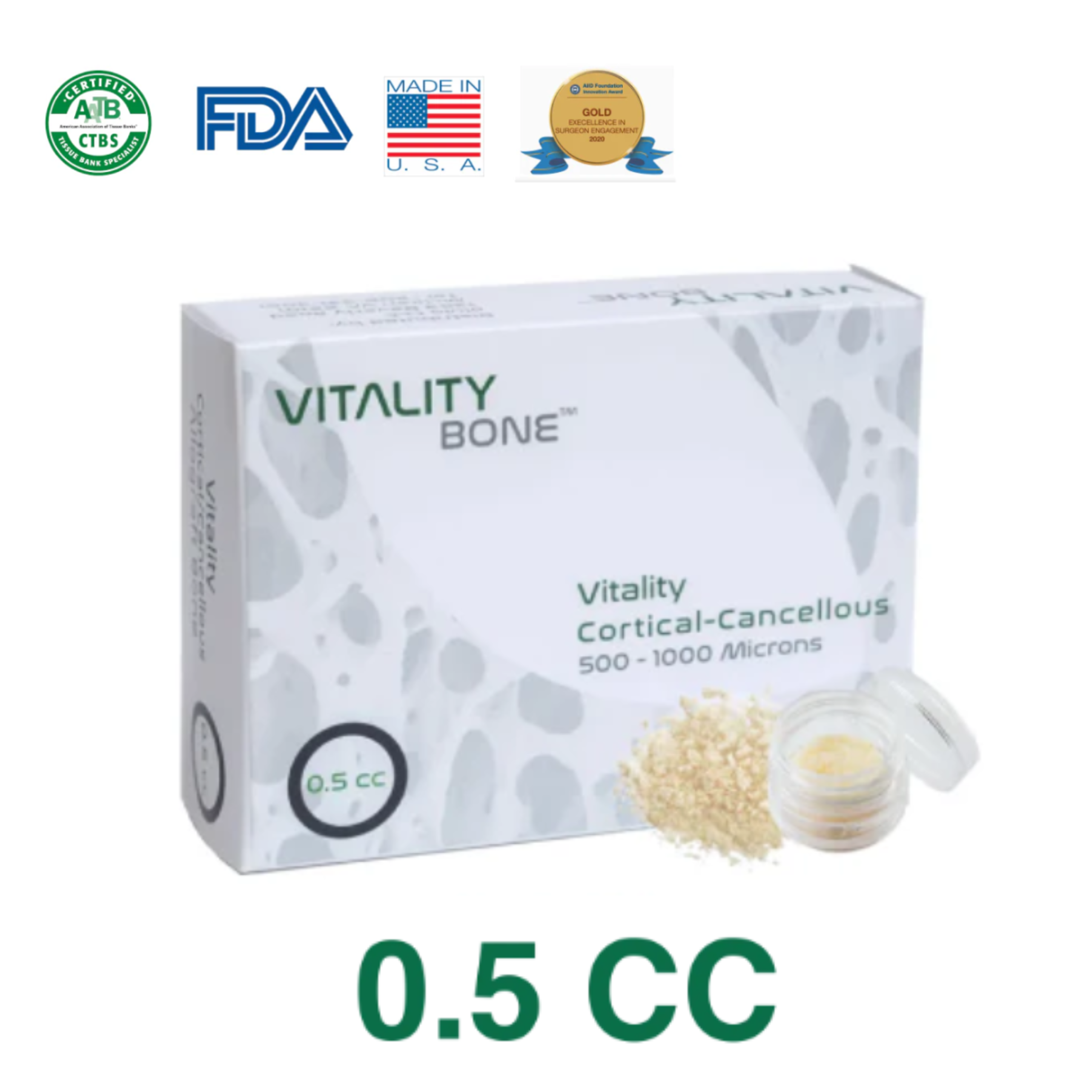
0.5 CC Allograft
$90.50 $63.35 Auto-Delivery
Good for practices that regularly perform smaller socket preservation or focused grafting cases.
- Smaller grafting cases
- Focused socket preservation
- Recurring low-volume inventory

1.0 CC Allograft
$126.00 $88.20 Auto-Delivery
A balanced inventory option for common implant-related grafting and ridge support needs.
- Common grafting workflows
- Implant-related procedures
- Balanced recurring supply

2.0 CC Allograft
$208.00 $145.60 Auto-Delivery
Useful for practices that need more graft volume for larger or more frequent procedures.
- Larger grafting workflows
- Ridge augmentation cases
- Higher-volume inventory needs


Ready to compare Vitality Bone options?
View 0.5 CC, 1.0 CC, and 2.0 CC 70/30 cortical-cancellous allograft options for implant-related grafting workflows.
Compare Vitality allograft products →
Dr. Hamid Shafie
Director of postdoctoral implant training at Washington Hospital Center
Department of Oral and Maxillofacial Surgery