

In the realm of oral surgery and dental implant procedures, vertical bone augmentation is a critical step in achieving successful results. The choice of how to approach this augmentation process hinges on the height of bone required for regeneration, and it's a decision that can profoundly influence the overall success of the procedure.
Quick answer
Vertical bone augmentation strategy often depends on how much vertical height must be regenerated. Smaller defects may use Vitality Cortical Cancellous Bone with a resorbable collagen membrane, while larger vertical defects may require additional space-maintaining support, such as a titanium-reinforced PTFE membrane, based on the clinician’s judgment.

Vertical bone augmentation decision guide
| Vertical height needed | Common approach | Why it may be used |
|---|---|---|
| 3 mm or less | Vitality Cortical Cancellous Bone with a long-lasting resorbable collagen membrane. | May help maintain space while supporting graft protection and healing in smaller vertical defects. |
| Greater than 3 mm | Vitality Cortical Cancellous Bone with a titanium-reinforced PTFE membrane when additional rigidity is needed. | May provide stronger space maintenance for larger vertical augmentation cases. |
Vertical bone augmentation strategy
When vertical height is 3 mm or less
For smaller vertical defects, clinicians may consider Vitality Cortical Cancellous Bone with a long-lasting resorbable collagen membrane. The allograft supports the grafted space, while the membrane helps separate the graft material from the soft tissue during healing.
Why this approach may help
Smaller vertical defects may not require as much rigid space maintenance. A resorbable collagen membrane can help protect the graft site while the clinician manages healing and soft-tissue closure.
When vertical height is greater than 3 mm
For larger vertical augmentation cases, clinicians may consider a titanium-reinforced PTFE membrane with Vitality Cortical Cancellous Bone. The reinforced membrane can provide additional support where maintaining graft space is more challenging.
Clinical planning note
The final membrane choice depends on defect size, flap stability, soft-tissue management, clinician preference, and the patient’s healing conditions.
Compare Vitality Bone Graft Options
Choose from 0.5 CC, 1.0 CC, and 2.0 CC Vitality mineralized allograft options for common oral surgery and implant-related grafting workflows.
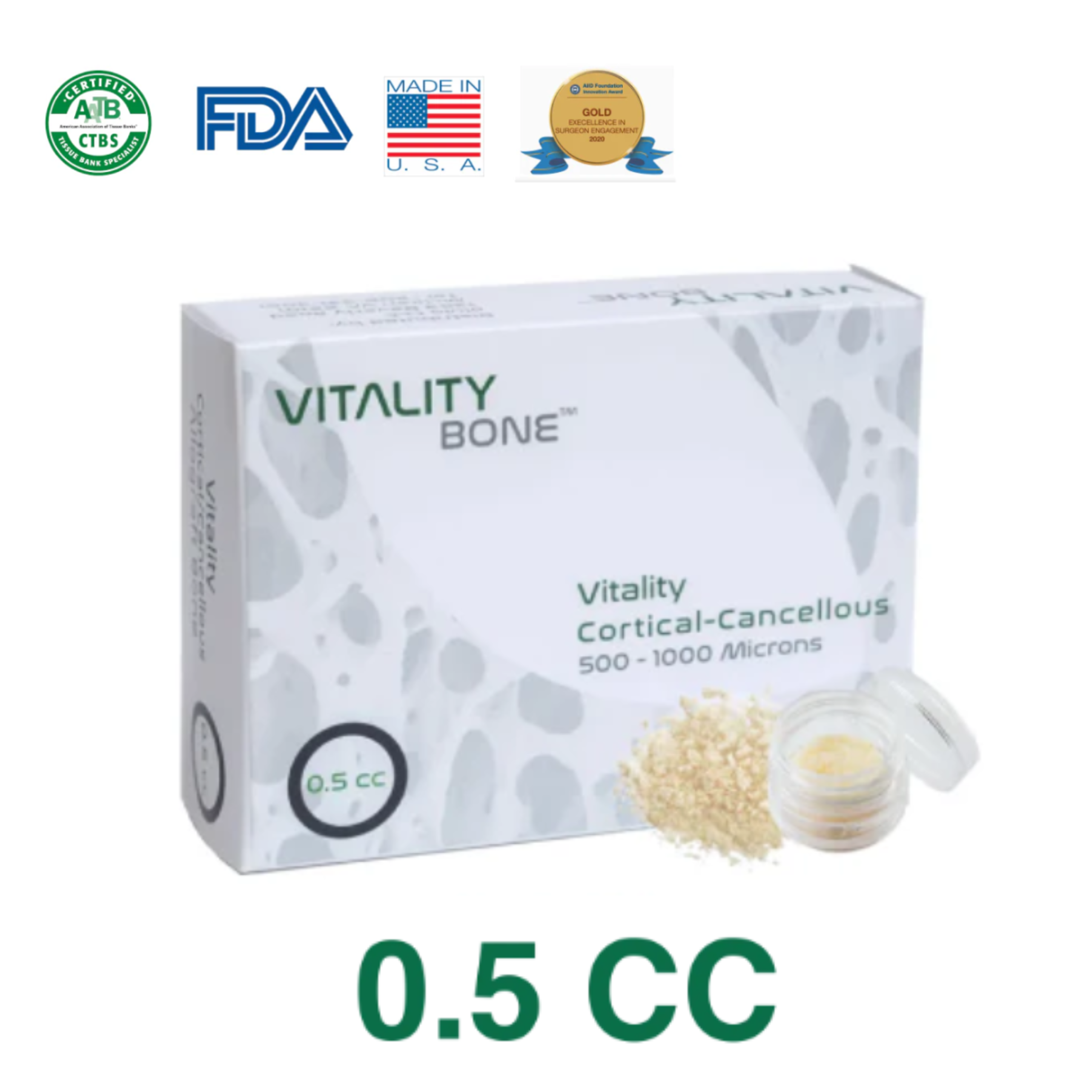
0.5 CC Allograft
Suitable for socket preservation, localized defects, and focused grafting procedures.
$90.50
$63.35 with Auto-Delivery

1.0 CC Allograft
A balanced option for implant site grafting, ridge augmentation, and moderate-volume defects.
$126.00
$88.20 with Auto-Delivery

2.0 CC Allograft
Useful for larger ridge defects, higher-volume grafting cases, and more extensive augmentation workflows.
$208.00
$145.60 with Auto-Delivery
Quality and traceability note
Vitality Bone allograft products are intended for clinician-directed grafting workflows and should be used according to applicable product instructions, sterile technique, and the clinician’s treatment plan.